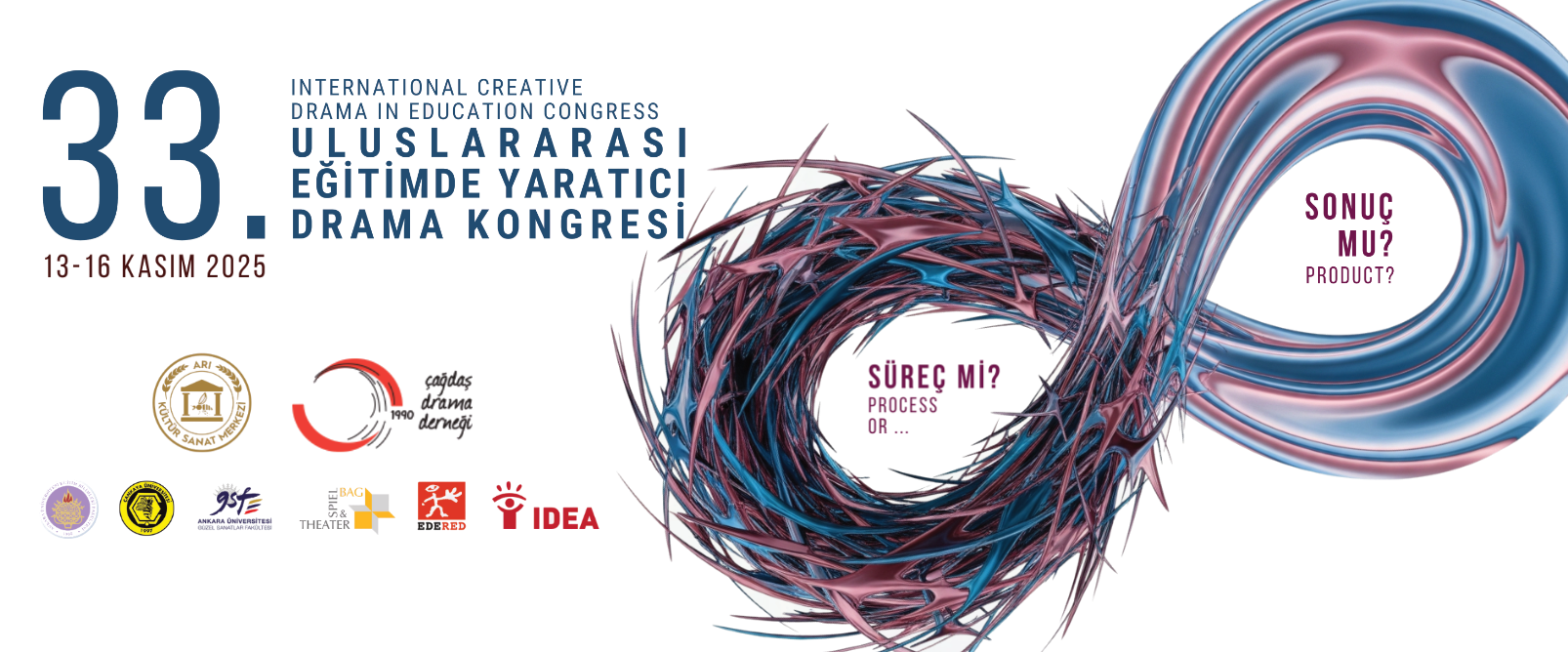

Theme: Process or Product?
The most fundamental characteristic defining the nature of creative drama in education is its process-based nature. Being process-oriented brings with it uncertainty. Uncertainty, in turn, means that everything develops through spontaneity and improvisation. Let's consider William Shakespeare's Hamlet. At the beginning of the play, young Hamlet has a suspicion about the manner of his father's death. Throughout the play, he pursues this suspicion. Shakespeare presents this search process step by step. In creative drama in education, however, we have only a starting point. This starting point has both an educational and an artistic quality. Based on this starting point, the facilitator and participants build the rest of the process step by step, exploring it based on improvisation and spontaneity. Therefore, it can be stated that creative drama in education shapes uncertainty in an educational and artistic way. This uncertainty does not mean that a session is conducted randomly or with the first ideas that come to mind; on the contrary, it means that a process structured towards a specific learning objective is shaped not by predetermined, ready-made patterns of information, but by the participants' experiences, contributions, and interactions within the process. The void of uncertainty is filled with the knowledge co-constructed by the facilitator and participants. Thus, creative drama in education ensures the participant's inclusion in the process, making it more democratic and liberating by moving beyond the teacher-learner dichotomy. An important part of the process is the product. This can be defined as a product far from being idealized; it is shaped by the polyphony of the process, reflecting the thoughts and feelings of everyone who contributed, and sometimes not conforming to specific formal patterns.
Structuring the relationship between process and product in this way in creative drama in education offers multi-faceted benefits to individuals. One of these benefits is particularly important for today's understanding of education: Creative drama in education equips individuals with the skill of coping with uncertainty. The ability to cope with uncertainty is one of the most needed skills for humanity from its very beginning to the present day. Throughout history, humans have tried to cope with the unknown and the uncertainty of the future. The two things they have done for this have been to focus on "process" and "product." In "societies without writing" (as Claude Lévi-Strauss, the most important figure in structural anthropology, preferred to call them, rather than 'primitive'), rituals and collective processes in harmony with nature were at the forefront; humans produced meaning by experiencing it within the process. The way to cope with uncertainty was to submit to and accept cyclicality. With the Agricultural Revolution, the focus on product increased; this created the need to obtain results, stock up, and plan for the future. This period can be seen as when a product-oriented mindset was formed. With the Industrial Revolution, processes were standardized, and results became measurable; humans tried to eliminate uncertainty as much as possible. Today's world is shaped by ever-accelerating production cycles, a hunger for instant results, and a concept of success measured by demonstrable outputs. In almost every field, from education to art, from politics to personal development, processes are shortening, experiences are packaged like fast food, and product-orientation can overshadow meaning.
However, a person should be defined not only by "what" they produce but also by "how" they produce it; not just by reaching the result, but by what they become on that journey. Today, however, this duality has become a source of tension. Those who adopt a process-centered approach see uncertainties like change, transformation, discovery, and creativity as areas for development; whereas those who are product-oriented perceive uncertainty as a threat and try to achieve secure and controllable results through outputs.
Creative drama in education allows space for error, uncertainty, discovery, and polyphony. With its gamified and interactive structure, it values not only the product but the process itself. However, when these processes sometimes intersect with performance, presentation, observability, or measurability, this question becomes inevitable:
Does the participant enjoy staying in the process, or do they want to get to the result quickly? Is the process more important, or the product?
The answer to this question says a lot about humanity's search for results in the face of uncertainty. It is at this point that creative drama in education opens up a space against the fast and result-oriented tendencies of our age, with features such as emphasizing the process and being based on participant creativity and improvisation. In the field of creative drama in education, debates on process- versus product-orientation also hold a significant place. There is no clear answer to these debates yet. With this congress, we aim to ask questions focused on the result and product, and to seek answers to these questions together.
With these questions, we invite you to rethink creative drama in education not only as a teaching method but also as an area of artistic expression. Where do the boundaries between creative drama and theatre begin and end? Are participant-centered processes the priority, or is it the aesthetic value of the resulting product? Although creative drama is fundamentally defined as a "process art," this process sometimes evolves into a visible product—sometimes planned, sometimes spontaneously. Establishing a balance between the experiential nature of the process and the expressive, shareable nature of the product in this transformation becomes one of the most fundamental inquiries of creative drama in education concerning process and product.
These inquiries lead the educator not only to a methodological choice but also to an ethical and pedagogical one. However, viewing the concepts of process and product as opposing poles can also mean misreading the multi-layered structure of creative drama in education. Because sometimes the sincerity of a process makes the final product more authentic; and sometimes a product goal makes the process more focused and profound.
This year's congress theme, "Process or Product?", invites us to rethink this fundamental dichotomy, often encountered in creative drama in education, not as a field of conflict, but as one of creative tension. In this context, we aim to open a multi-faceted discussion with participants around the following questions:
This congress aims to lay the groundwork for a re-discussion of process and product not as mutually exclusive, but as two concepts that nurture each other.
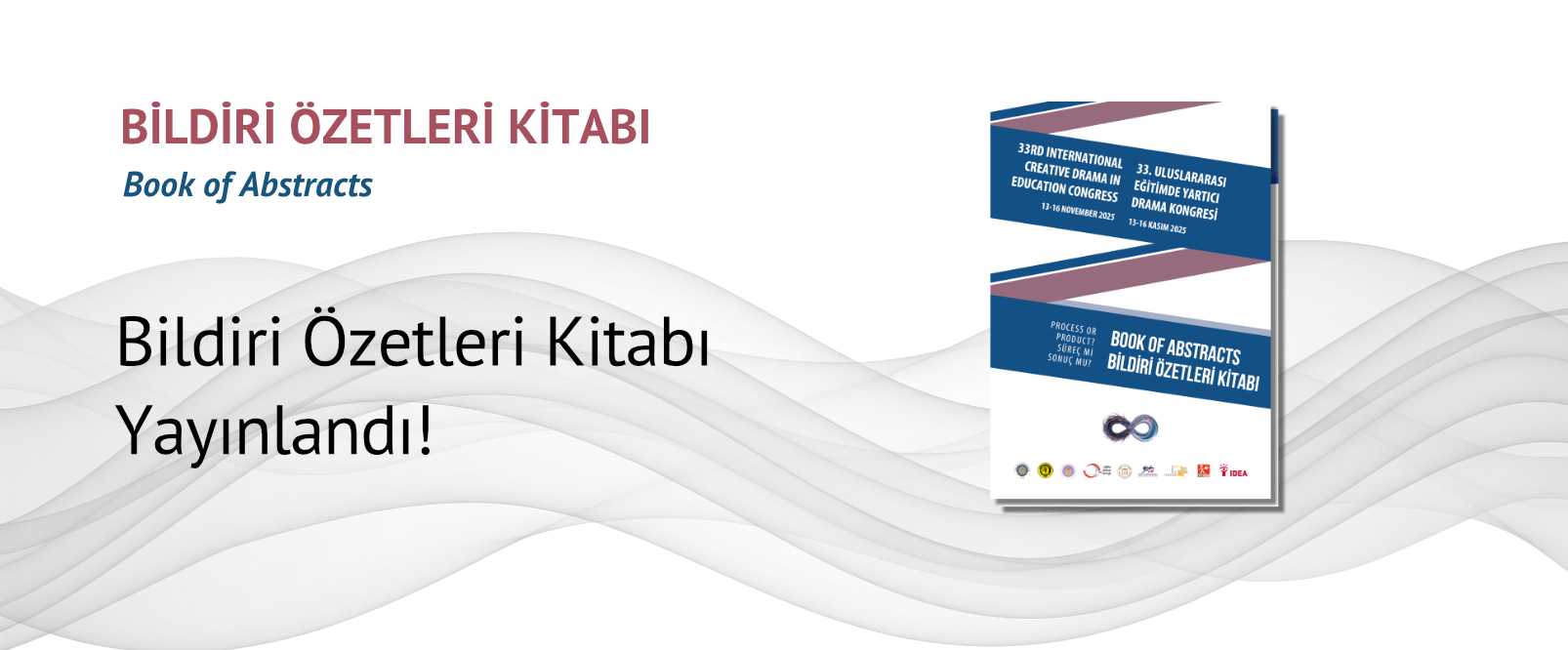
This year, at the 33rd International Congress of Creative Drama in Education, we invite you to the Arı Culture and Art Center between November 13-16, 2025, to think, discuss, experience, and redefine these fundamental issues together. Our congress includes sessions aimed at the following professional and participant groups:
1. Academics and Researchers
2. Teachers and Educators
3. Drama Leaders and Practitioners
4. Artists and Theatre Professionals
5. Civil Society and Public Representatives
6. International Participants
7. Students and Volunteers
Assoc. Prof. Dr. İhsan Metinnam
President of the Congress Organizing Committee